Hearing God’s Voice

“The Lord God called to Samuel.  He ran to Eli and said, ‘Here I am.  You called me.’ ‘I did not call you,’ Eli said, ‘Go back to sleep.’”  (1Samuel 3:4-5)

This happened three times before Eli realized that the Lord was calling Samuel who did not recognize the Lord’s voice.  Each time he heard his name being called, Samuel went to Eli, thinking it was he who was calling him.  After the third time, Eli guided Samuel to say, “Speak, Lord, your servant is listening.”  Samuel went on to become one of the great prophets of the Old Testament.  “The Lord was with him, not permitting any word of his to be without effect.” (1 Samuel 3:19)

Knowing when we hear God’s voice is a major challenge for most of us.  Our lives are filled with continuous noise in today’s culture.   Television, radio, robo calls, texts, and e-mail boxes stuffed with spam — all contribute to a cacophony of noise that tends to drown out the Lord’s whispers to our heart and spirit.  Do we recognize God’s voice when he is calling us or asking us to do something?

When I was in my mid-30’s, I started to serve as a religious education teacher for high school students in our parish in Armonk, N. Y.  One of the other teachers whose name was Ann befriended me.  She was a noticeably joyful person and began to invite me to various prayer meetings, conferences and other spiritual related events.  After declining each of her invitations over several months, she started inviting my wife who agreed to attend a Life in the Spirit program at a nearby parish being conducted by some nuns from Scarsdale.  The program took place over five evenings from Sunday through Thursday.

My wife asked if I wanted to join her but I initially declined, indicating I had a brief case full of work.  Each night when she came home, I noticed how happy she seemed to be. On the fourth evening when she walked in the door, she was absolutely radiant.  Then she said, “You know I think I could forgive almost anything of anyone.” 

I thought to myself, “Wow! I have to check this out.”  I told her I wanted to join her the next evening even though it was the last evening and I had missed the four previous sessions.  That night, I met the Lord Jesus Christ in a new and very personal way, and my life was forever changed.  I was later prayed with to experience being filled with the Holy Spirit, and I have been trying to walk every day since with the Lord in all the venues of my life – family, work, social and ministry. 

Like Samuel, I was not recognizing the Lord’s call when Ann was extending me all of those invitations. It was what I saw God doing in my wife’s life that helped me to respond to his call in my life.

Are you able to hear the Lord’s voice through the noise of everyday life?

Imitating the Star

 “When Jesus was born in Bethlehem of Judea, in the days of King Herod, behold, Magi from the east arrived in Jerusalem, saying, “Where is the newborn king of the Jews?  We saw his star at its rising and have come to do him homage.” (Mt. 2:1-2)

As we know from listening to the story of the Magi every Christmas season, it was the star that led them to the Christ child.  Saint Leo the Great, Pope from 440 – 461, said we should imitate the star of Bethlehem in guiding and leading people to Jesus.  

Just as God took on flesh and blood through the power of the Holy Spirit with the Virgin Mary, so too, he takes on flesh and blood in us through the power of Holy Spirit.  God calls us to be his presence in the world and to bring that presence to the people in our lives – family, friends, colleagues and strangers.  The following is a story of my friend, John, who did just that.   

John was a county prosecutor from Duluth, Minnesota.  One of his early prosecutions involved a former high school friend, Jim.  Over the next 26 years John would prosecute Jim a dozen times for theft-related crimes to support a chemical dependency.  During the first few prosecutions John looked on Jim as just another hopeless criminal.  Then he started praying for Jim.  In the last prosecution of Jim it was determined that he was terminally ill with sclerosis of the liver, and the judge assigned him to a hospice outside of prison.  Jim asked his attorney to ask John to pray for him. 

Over the next six months, John did more than just pray for Jim.  He visited him two to three times a week at the hospice facility.  They reminisced about growing up in the 1950s and talked about their favorite baseball teams.  They also started reading the Bible together.  That fall, Jim repented of his sins and surrendered his life to Jesus Christ.  He died in late November.

“Over those last six months I frequently called Jim ‘brother’ because we had become brothers in Christ,” said John.  “Jim loved reading and praying the psalms.  God used Jim to teach me about acceptance of suffering and perseverance, and he showed me that it’s never too late to say yes to the Lord, no matter what we have done in the past.”

John concludes, “Because God answers prayers, Jim said ‘yes’ to Christ before he died, and I know he is in paradise today – just like another thief who died on a cross next to Jesus 2000 years ago.”

Like the star of Bethlehem and the example of John, have you led anyone to Jesus through conversation, prayers, and love? 

Why We Celebrate Christmas

After hearing the Christmas story over and over, year after year, its true meaning and impact may fade against the backdrop of today’s culture.  Yet, if we think about it, God’s willingness to become one of us is the greatest act of humility and love in all of history.  In John’s Gospel we read, “The Word became flesh and made his dwelling among us.  We have seen his glory, the glory of the One and Only, who came from the Father, full of grace and truth.” (John 1:14 NIV)

Here we have God the Father, creator of all that exists, creator of the millions of galaxies and the billions of stars whose distance is measured in light years. Here we have God who created the atom and the molecule whose size is measured in nanometers – that’s one billionth of a meter.  This God, who created the human person with a body, soul, and mind, different from all other creatures, became one of his created in order to free each of us from our sins and the world from its bondage to sin – to reconcile us to him and one another.   

Father William Barry, in his book, A Friendship Like No Other, says, “God took humanity seriously enough to become one of us, and we do God no service if we downplay what God has done in becoming human.” 

It seems like it is easier for us to view Jesus in his divinity than it is for us to accept fully his humanity.  But God in Jesus was a real human person, born of Mary in the humblest of circumstances.  He had to be toilet trained, learn a language and be raised from childhood to an adult just as we all have been.  We can be sure that Jesus’ humanity felt the sting of the whip and the piercing pain of the nails.  God is no stranger to suffering.  God in Jesus knows what human life is like from the inside.  His desire for friendship, to dwell with us and in us knows no bounds.

Genesis tells us we were created in the image of God, but from the very beginning, we have failed to live up to that expectation.  God had to show us how to be his image by becoming one of us. After showing us by his example, he then sent us the Holy Spirit to live in us and enable us to be his presence and bring his presence to the people and circumstances of our lives.

A cobbler does not become a shoe, a cabinet maker does not become a cabinet, but God the Father and creator of all that exists became one of us.  Little wonder that history’s calendar is measured in terms of before and after this event.

Let us celebrate the birth of Jesus for what it is – the greatest act of humility and love in all of history.

Praising God for His Actions

“My soul proclaims the greatness of the Lord; my spirit rejoices in God my savior.” (Luke 1:46)

We may recognize this verse as the first line of Mary’s Magnificat, as she praises God for his request for her to be the mother of his Son, Jesus.  According to the Gospel of Luke, she offers this prayer right after entering the house of Zechariah and Elizabeth to serve Elizabeth during her pregnancy with John the Baptist.  Through the Holy Spirit, Elizabeth recognizes Mary as “the mother of my Lord,” and says to her, “Blessed are you who believed that what was spoken to you by the Lord would be fulfilled.” (Luke 1:45) 

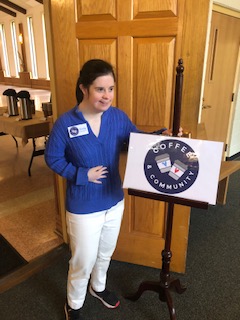
I would like to praise God for a particular blessing that he has bestowed on our daughter, Emily, who was born with Down syndrome.  After graduating from St. Paul VI Catholic High School in the Arlington, Virginia Diocese, one of the first Catholic high schools in the nation to offer special education, she subsequently went to work for a bakery and catering business involved in various food preparation tasks, including dog biscuits.  The bakery employed as many as thirty-five individuals with intellectual and developmental disabilities, some of whom included friends from her high school. 

Emily worked for the bakery for twelve years until a number of circumstances, including COVID, caused the bakery to close its doors.  For more than two years we have been searching for work opportunities for Emily, but none appeared to work for her. We prayed continuously that God would find something for her.

This past summer her sisters came up with the idea for her to offer “Coffee and Community” after daily mass at our parish church, St. Mark.  We got approval from our pastor, her sisters developed signage and name tags, and we were able to contract with a job coach to assist in making the coffee and set up.  In October she began to offer Coffee and Community every Tuesday and Thursday after daily mass. Emily helps my wife bake cookies to go with the coffee. The church staff is very supportive, and the people of our parish are getting the opportunity to interact with someone with a disability.

Emily was born with an inclination to love.  When she meets someone, her first reaction is to give them a hug.  During this season when we celebrate God becoming one of us, we praise God and give him thanks for his care and provision for Emily.  She is now doing what she loves to do most – greeting people with her beautiful smile and giving them a hug. 

My soul proclaims the greatness of the Lord, and my spirit rejoices in God my savior.   

Wheat and Chaff

“He will baptize you with the Holy Spirit and with fire.  His winnowing fan is in his hand to clear his threshing floor and to gather the wheat into his barn, but the chaff he will burn with unquenchable fire.”  (Luke 3:16, 17)

These are the words of John the Baptist describing Jesus who will come after him.  Like a lot of scripture, these words can have multiple levels of interpretation.  As in the parable of the Last Judgment with its separation of the sheep and the goats, here we have the separation of the wheat and the chaff.  Both references point to a separation of the good and the bad, with the potential consequence of determining our eternal destination.

John’s reference to the wheat and chaff likely relate to our present condition since he is talking about what Jesus will do for us – he will baptize us with the Holy Spirit and with fire. If we accept Jesus’ baptism of the Holy Spirit, he will separate the wheat from the chaff — preserving the wheat and destroying the chaff.

Because of our fallen human nature, we all have chaff in our lives.  Jesus invites us to accept his winnowing fan — God’s grace to separate and remove the chaff.  For most of us this is a life-long process.  The chaff can represent the more obvious sins such as those that violate the Ten Commandments, or the more subtle forms, such as failures to love as described by Paul in 1 Corinthians 13:4-7, or failures to reflect the Beatitudes in Mt. 5:1-12.

In our preparations to celebrate God becoming one of us in the birth of Jesus, perhaps we could spend some of the same energy seeking Jesus’s help in removing the chaff from our lives as we do in buying presents, decorating our houses and preparing the Christmas meal.   

Some questions we might ask ourselves this week include: Am I patient and kind with store clerks when shopping?   At holiday parties, do I listen more than I talk?  Do I keep my anger in check when I feel I’m being slighted?  Am I willing to adjust my plans when someone needs help?  Am I spending time with Jesus as well as with family and friends?

“For to us a child is born, to us a son is given, and the government will be on his shoulders.  And he will be called Wonderful Counselor, Mighty God, Everlasting Father, Prince of Peace.” (Isaiah 9: 6 NIV)

Unlikely Heralds

“When they saw this, they made known the message that had been told them about this child.  All who heard it were amazed at what had been told them by the shepherds.”  (Luke 2: 17-18)

The Gospel of Luke reports that at the time of Jesus’ birth, shepherds nearby were told by an angel that a Savior, the long awaited Messiah, was born. They were told where they could find him and how they would recognize him — in Bethlehem, tightly wrapped in strips of cloth and lying in an animal’s feeding trough. 

God chose shepherds, one of the humblest of occupations at the time, to be the news media of the day to spread the word about God becoming one of us.

We can only imagine the reaction of Mary and Joseph to having some complete strangers visit them and share a story that confirmed what they, too, had been told by an angel – that the son born to Mary was the Son of God, Savior, and Messiah. 

A savior of the world being born was of course amazing news.  This good news that the shepherds first proclaimed 2000 years ago is just as important to the world today as it was then.   A savior has been born!  The creator has become one of his created!  An anointed one has come to reconcile God and mankind, and be an example in reconciling each of us to one another.  Through the power of the Holy Spirit, this savior offers to dwell in us and enable us to be and bring his presence to the people and circumstances in our lives.   

Like the shepherds, we may consider ourselves unlikely heralds that Jesus is still present in the world today, but he is present to all who accept his offer to dwell in them.  We have the same opportunity as the shepherds to spread the word about Jesus in what we have seen, heard, and experienced. 

Over the past few years, I have been participating in a Christian ministry to the local jail.  The venue of the jail has certainly taken me outside my comfort zone.  But on one occasion I found myself sharing about how in between the first and second coming of Jesus, there is a third coming – when we invite Jesus to come and reside in our hearts. Sharing how Jesus changed my life prompted three of the inmates to share how Jesus had changed their lives.  This was remarkable because inmates are very cautious about sharing anything personal in front of one another. 

As with the shepherds, I was an unlikely herald in the venue of the jail, but telling others about Jesus is part of God’s plan for us.  All who hear will be “amazed!”    

Are we following the example of the shepherds in telling people about Jesus?

What Are You Thankful For?

“Enter the temple gates with praise, its courts with thanksgiving.  Give thanks to God, bless his name; good indeed is the Lord, whose love endures forever, whose faithfulness lasts through every age.” (Psalm 100:4-5)

What are the chances that 102 pilgrims sailing from Plymouth, England in 1620 would encounter two English speaking Indians on the North American continent?  These Indians, named Samoset and
Squanto, became instrumental in the pilgrims’ survival.  They helped the pilgrims learn how to plant corn, catch fish, and trade with friendly Indian tribes. 

Was God looking out for the pilgrims?  Apparently the pilgrims thought so.  At the end of the summer of 1621, after building new dwellings, planting and harvesting food to get them through the next winter, the pilgrims were “brimming over with gratitude” and Governor Bradford declared a day of public thanksgiving in October.  (See The Light and the Glory by Peter Marshall and David Manuel.)

As our national day of Thanksgiving approaches this week, I pause to reflect on a long list of blessings for which I am deeply thankful:

  • A Father God and his son Jesus Christ who love me and offer to dwell in me through the Holy Spirit and give me purpose in loving and serving the people in my life.
  • A loving wife of 59 years and a mutual love that grows deeper each year.
  • A family of five children, including three sons-in-law, one daughter-in-law and 13 grandchildren who are believing Christians and enjoy one another’s company.
  • An adult daughter with Down syndrome whose bright smile, hugs and inclination to love shows the rest of us the face of God; and who recently started Coffee and Community after daily mass on Tuesdays and Thursdays at our local parish.
  • Christian friends from the People of Praise community, Christians in Commerce, St. Marks Catholic Church and our neighborhood who would take a call at 3:00 A.M. if the need arose.
  • A declining PSA after 38 sessions of proton radiation for recurrent prostate cancer. 
  • Meaningful work in business and ministry spanning 60 years.
  • Material blessings that are sufficient.

This list does not mean we are exempt from trials and temptations, for who can escape them in this world.  But we share the God of the pilgrims who calls us, strengthens us, and upholds us.

What are you thankful for?  Make a list and offer it up to God in thanksgiving.

Praying for the Right Words

“In the same way, the Spirit helps us in our weakness.  We do not know what we ought to pray for, but the Spirit himself intercedes for us.” (Rom. 8:26)

Have you ever strained for what to say to a person at a critical moment?  Perhaps it is a friend who has lost a spouse or child; maybe it’s a friend who is depressed from losing his or her job, or a teenage son or daughter in need of correction.  In such moments, do we ask God and the Holy Spirit to give us the right words?

A few years ago, I came home and my wife said a former secretary from my work at Mobil had called and wanted me to call her back.  “She didn’t sound well,” my wife said.  I was astounded.  It had been more than forty years since she had been my secretary!  What could she possibly be calling for? 

I called her back.  She was indeed very ill.  She had had cancer, followed by a stroke, and was now confined to a wheel chair.  She thought she was dying, and she wanted to thank me for encouraging her to go back to school to finish her college education so she could move into higher level jobs.  She did complete her degree in an evening program, and later enjoyed a successful career at Mobil moving through several positions.

As I was talking with her, I was prompted to pray with her, but I was resistant.  I started to have a second conversation in my mind with the Lord.  Since I am used to praying in the name of Jesus, I asked the Lord, “How do I pray for her?  She is Jewish.”  The thought came into my mind, “Pray in the name of the Father.”  So I asked if she would like me to pray with her.   

She said yes.  So, I prayed in the name of the Father to bring her comfort and healing.  I finished by saying , “Marilyn, I am going to continue to pray that you will be able to get out of that wheel chair and walk again on your own, and when you do, I want you to call me and let me know. 

A few months later I received a call.  Mr. Dalgetty, you told me to call you when I was able to get out of this wheel chair and walk.  Today, I took my first steps!”   

The Holy Spirit is always present to give us the right words for the circumstances before us.  Jesus says all we have to do is ask. (Luke 11:13)

In challenging circumstances, do you call on the Holy Spirit to give you the right words?    

Revealing the Father to Others

“I have revealed you to the ones you gave me out of the world.” (John 17:6)

These are among Jesus’ last words on the night before he was arrested.  He is praying to the Father, asking that he protect the disciples and observes that he has revealed the Father to them through his teaching, his miracles and the example of his life.  He had earlier told Phillip, “Anyone who has seen me has seen the Father.” (John 14:9)

Just as Jesus saw his responsibility to reveal the Father to his disciples, so too do we have a similar responsibility to reveal the Father to the people God puts in our lives.  This certainly includes our spouse and children for whom we have a special responsibility, but it also includes friends and colleagues. With respect to our children, we have a teaching responsibility similar to Jesus.  The Church assists us in this effort through religious education, Sunday school and sermons. 

With respect to our spouse, friends and colleagues, the primary way of revealing the Father is through the example of our lives and in our actions of love and service.

I am reminded of a former boss, colleague and friend who passed on a few years ago.  Tom was General Counsel of Mobil’s worldwide marketing and refining operations.  I reported to him in various assignments over eleven years. 

Without ever mentioning the words God or Jesus, Tom revealed the presence of the Father in his life by his example.  He didn’t talk much about his faith, but he lived it in the daily actions of his life.  While demanding the highest quality of legal services from the lawyers and staff he oversaw, he was always fair and truthful in dealing with people and what was best for them in their career development and training. 

He never winced from speaking the truth to management on controversial legal issues. Once he was convinced that the legal work of his staff was correct, he fully supported that work with senior management.  Tom’s leadership of our legal group reflected integrity, excellence and a special respect for all people.   

When I think about Jesus’ words and example of revealing the Father to his disciples, and the example of Tom’s life, I am prompted to reflect on whether my actions and words have been revealing the Father to the people God has put in my life.  In the Parable of the Talents, we see that God expects us to be good stewards of the talents, time, and possessions he entrusts to us. (Matthew 25:14-30)  This also includes the people he puts in our lives – our spouses, children, work colleagues and friends.      

Richard Blackaby in his book, Spiritual Leadership, says the primary goal of spiritual leadership is “taking people from where they are to where God wants them to be.”   

Are we helping the people in our lives come to know the Father and be where he wants them to be?

Peace – God’s Elusive Gift

“Peace I leave with you; my peace I give you.”  (John 14:27) 

These were among Jesus’ last words to the disciples on the night before his arrest.  In spite of these words, our experience tells us that ongoing peace is a challenge for us to attain, particularly the kind of peace St. Paul describes as passing all understanding. 

Thomas A Kempis in his book, Imitation of Christ, says, “Our peace consists in humble bearing of suffering and contradictions, not in being free of them, for we cannot live in this world without adversity.  He who can best suffer will enjoy the most peace.”

Dietrich Bonhoeffer, a German Lutheran minister was imprisoned by the Nazis in 1943 and executed just days before the war’s end in April, 1945. Eric Mataxas, in his biography of Bonhoeffer, says that he brought peace and calm to his fellow prisoners.  “His strength was borrowed from God and lent to others,”said Mataxas. 

On the day of his execution, the prison doctor observed, “I saw Pastor Bonhoeffer kneeling on the floor praying fervently to his God.  I was most deeply moved by the way this lovable man prayed, so devout and so certain God heard his prayer.  At the place of execution, he again said a short prayer, and then climbed the steps to the gallows, brave and composed.  I have hardly ever seen a man die so entirely submissive to the will of God.”

Most of us are not likely to experience the challenges that Dietrich Bonhoeffer did, but as Thomas A Kempis says, we cannot live in this world without adversity– sickness, unemployment, estrangement from loved ones, a difficult boss, caring for a disabled relative – the list is endless.  Are we able to handle these challenges with the kind of peace that Jesus is talking about?

In the prime of my career as an attorney for a large company I declined a promotion to avoid a relocation that my wife and I believed would have adversely affected our family which included three teenage daughters at the time.   For a couple of years I was not very peaceful as I was asked to take an assignment I held once before so someone “more promotable” could take my job. 

Then our company had an incident at one of its facilities for which I was responsible for overseeing legal services.  We had several lawsuits, regulatory actions, a legislative effort to outlaw our operations and even a criminal action against two of our managers.  We were able to resolve all of these matters in a satisfactory manner, and it turned out to be the most challenging and rewarding legal work of my career.

In Jesus’ closing moments with the disciples he said, “I have told you these things, so that in me you may have peace.  In this world you will have trouble.  But take heart!  I have overcome the world.” (John 16:33)

How do you find your peace?