
Category Archives: Uncategorized

God’s Attending Angels

“An angel from heaven appeared to him and strengthened him.” (Luke 22:43)

The Gospel of Luke reports that after Jesus submitted to the Father’s will to accept the cup of his passion, God sent him an angel to strengthen him to endure all that he would be facing.

Our human suffering, however severe, may never equal Jesus’ “agony in the garden.”  Yet, how often have we seen people endure incredible suffering from a terminal illness or the loss of a loved one with determined faith, while still maintaining an unusual peace and joy that can only come from God?

Sometimes God uses one of his special angelic messengers to bring strength and consolation.  Sometimes he uses family or friends to perform this role.

This brings to mind an experience I had when I was 15 years old following surgery to correct a defective sternum bone that I was born with.  The lower part of my sternum was bent inward that had the effect of crowding the heart and lungs as I started growing in my teen years.  This apparently caused an enlarged heart, severely impacting my future health and long term survival.

We were living in Mason City, Iowa, about 120 miles north of Des Moines.  A thoracic surgeon in Des Moines had developed a corrective repair that involved splitting the sternum from the rib cage, inserting a bone strut from one side of the rib cage to the other and laying the sternum back down and wiring everything back together.

This was considered experimental surgery in the mid-1950s, when they were not quite as good at pain management as they are today.  As a result, I was in a lot of pain from the surgery and discomfort with all of the tubes continuously pumping fluids from my chest cavity.  I remember telling my parents, to their consternation, that I would not have done this if I knew it was going to be so bad.

On the fourth day, Father John from our parish in Mason City visited me.  We had become very close friends during the course of his weekly instructions for me to join the Catholic Church a couple of years earlier.  To make this visit, he had to drive two hours after Sunday morning masses from Mason City to Des Moines, and then two hours back in time to say a Sunday evening mass.

He talked with me, encouraged me and said a prayer with me.  He was like the visitation of an angel lifting my spirits.   I didn’t complain any more to my parents about the surgery, and spent the rest of the summer recuperating.  I have always remembered how his visit turned things around for me, along with the sacrifice it took for him to make it happen.

Like Father John, may we be inspired to serve as angels to others in their time of need.

“For he will command his angels concerning you to guard you in all your ways; they will lift you up in their hands, so that you will not strike your foot against a stone.” (Psalm 91:11-12)
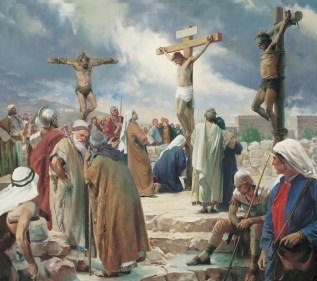
What Happened to the Other Thief?

crucifixion-christ-anderson-39598-wallpaper“Be always on the watch, and pray that you may be able to escape all that is about to happen, and that you may be able to stand before the Son of Man.” (Luke 21:36)

These are words of Jesus to the disciples as they gazed on the grandeur of the temple in Jerusalem.   Jesus seems to be mixing descriptions about both the destruction of the temple by the Romans in 70 AD and his second coming at some later date.

His message to the disciples and us: Be watchful; be ready to meet him either at our physical death or at his second coming if we are still alive.   He says, “Be careful, or your hearts will be weighed down with dissipation, drunkenness, and the anxieties of life, and that day will close on you unexpectedly like a trap.” (vs. 34)

We know neither the day of our death nor the day of Jesus’ second coming, only that both will certainly occur.  Jesus is urging us not to let the cares of the world overtake our lives and push aside God’s desire and purpose for each of us.  Since the non-physical aspect of our existence (our souls) lasts beyond our physical lives, Jesus is saying he wants us to end up with the Father and not separated from him forever in hell.

We may not hear a lot about hell these days.  It is interesting that during the apparitions of Mary at Fatima, Portugal, in 1917, she showed the three children to whom she appeared a short vision of hell to emphasize its horrors and the absolute necessity to pray for the salvation of souls and the direction of the world at large.  She warned that if people did not change their ways, a worse war than the present would come and that Russia would continue to spread its errors and persecution of the church.

This past weekend I attended an Arlington Diocesan Men’s Conference at which one of the speakers, Father Donald Haggerty, raised the question of what happened to the other thief at Jesus’ crucifixion.  Luke reports that he hurled insults at Jesus, mocking him and saying, “Aren’t you the Christ.  Save yourself and us.”  The so-called good thief rebuked him, and then asked Jesus to remember him when he came into his kingdom.  We all remember Jesus’ response, “Today you will be with me in paradise.”

Father Haggarty noted that Mary, who was standing at the foot of the cross, watched the other thief die, with his soul lost forever.  Haggarty suggested that Mary’s soul was pierced not only for the death of Jesus, but for the other thief as well.  He concluded, “It is a serious thing to be aware of souls.”

With the busyness of everyday life and the distractions of getting ahead in this world, we may tend to neglect our own souls and the souls of loved ones and others.  During this lent as we prepare to give special attention to the death and resurrection of our Lord, may we renew our prayer and actions to grow closer to God and pray for the souls of others.

“Father Abraham, have pity on me and send Lazarus to dip the tip of his finger in water and cool my tongue, because I am in agony in this fire.”  (Luke 16:23)

“For God so loved the world that he gave his one and only son, that whoever believes in him shall not perish but have eternal life.”  (John 3:16)

Being Blessed by Persecution

“The apostles left the Sanhedrin, rejoicing because they had been counted worthy of suffering disgrace for the Name.” (Acts 5:41)

Peter and John had healed a cripple by the temple gates by invoking the name of Jesus. The Sanhedrin called them to account for their actions, ordering them not to speak in the name of Jesus in the future. They refused, and the Sanhedrin was furious, wanting to put them to death.  A Pharisee, named Gamiliel cautioned them that if what the apostles were doing was of human origin, it would eventually fail, but if it was from God, the Sanhedrin may find themselves fighting against God.

Then in a phrase easily overlooked because it is a part of a larger story, the Book of Acts reports that the Sanhedrin “had them flogged” before they let them go. (Acts 5:40)

Imagine!  For healing a lifelong cripple, the Sanhedrin had the apostles beaten with whips. In Roman times this was done by stripping the person of his clothes, tying his hands to a post and beating him with a whip that had leather straps and sometimes pieces of nails or other objects at the end of the straps to more deeply tear into someone’s flesh.

While we may step back in horror today at such cruelty, we are reminded of Jesus’ last Beatitude, “Blessed are you when people insult you, persecute you and falsely say all kinds of evil against you because of me. Rejoice and be glad, because great is your reward in heaven.” (Mt. 5:11-12)

And what was the apostle’s reaction to being flogged?  Luke tells us that they rejoiced for having been worthy to suffer for the name of Jesus.  

Several years ago at a colleague’s retirement party, I honored him for the way he treated people with care and respect.  In doing so, I told Jesus’ parable of the Good Samaritan who came to the aid of someone who had been attacked by robbers and left to die by the side of the road.  Apparently I unknowingly offended someone when I made reference in the story to a Levite and a Jewish priest who had passed by the person having been robbed.  The next evening I received a threatening phone call.  I was accused of maligning Jewish people and their religion, and that the caller said he would get even with me.

The caller did not allow me to apologize or explain what I was trying to say with the parable, only that I should watch out because he was going to get even.  I can’t say that I rejoiced like the apostles, not knowing how the caller was going to get even,

Of course, my small example does not begin to compare to the way Paul and other early Christians were persecuted, or for that matter, the millions of Christians that are being persecuted in the world today. Christianity Today International reports that 215 million Christians experience at least a high level of persecution.  One example cited twenty-three Christian leaders that were killed in Mexico in 2017.

While Christians in our country have not experienced persecution as in some countries, we are not immune from this concern in view of societal trends dealing with life, marriage, and sexual conduct.

But Jesus says, “Blessed are those who are persecuted for righteousness, for theirs is the kingdom of heaven.” (Mt. 5:10)

Surviving this Corrupt Generation

“Save yourselves from this corrupt generation.” (Acts 2:40)

These were words from Peter to the people who were present when God poured out his Holy Spirit on the apostles and the early Jewish followers of Jesus at the Feast of Pentecost.

This has long been regarded as the start of Christ’s church.  The Book of Acts tells us that those looking on heard a sound like the blowing of a violent wind and saw about 120 of Jesus’ disciples praying in languages not their own, praising and worshiping God.  They asked Peter what this all meant.

Peter said that Jesus, who had performed many miraculous signs among the people, had been executed by the authorities, was raised from the dead by God and was the long awaited Messiah foretold by the prophets.  He was now pouring out his Holy Spirit as he had promised on all that believed in him.  Peter urged all that were listening to “save themselves from this corrupt generation.”

Though Peter’s words were directed at the people in front of him, they are in fact timeless, applicable to generations beyond his own, including our present generation.  The loss of respect for life in our current day, the confusion over truth, the erosion of integrity, the diminishing state of sexual morality and the abandonment of principles of natural law, all point to corruption in our present generation. 

So what should we do?  Interestingly, the people of Peter’s generation asked the same question.  He told them, “Repent and be baptized, every one of you, in the name of Jesus Christ for the forgiveness of your sins.  And you will receive the gift of the Holy Spirit.”  He went on to say that this “promise is for you and your children and for all who are far off—for all the Lord our God will call.” (Acts 2:38-39)

That’s us! We are far in distance and time, but Peter’s words are meant for us just as they were to the people of his day.  Repent of our sins, believe in the Lord Jesus Christ, and we can receive the gift of the Holy Spirit to enrich and empower our lives.

Then, we can be a leaven to our present generation by bringing the presence of Christ to the people and circumstances of our lives through our words and actions.

Jesus said to Peter, “And I tell you that you are Peter [rock], and on this rock I will build my church, and the gates of Hades will not overcome it.” (Mt. 16:18)

As the psalmist says, “But you, O Lord, sit enthroned forever; your renown enduring through all generations.” (Psalm 102:12)

A Warning to Parents

965aac266ea6eda6473b61b29328074c--primary-talks-lds-primary“People were also bringing babies to Jesus to have him touch them.  When the disciples saw this, they rebuked them.” (Luke 18:15)

When Jesus saw what the disciples were doing he chastised them and said, “Let the little children come to me, and do not hinder them, for the kingdom of God belongs to such as these. (vs. 16)

Apparently the disciples thought that they were protecting Jesus from people wanting to bring their children to him.  But Jesus didn’t think he was being bothered.  He said, “Do not hinder them.”

There is a lesson to us in these words.  God does not want us to be an obstacle to our children being brought to him or finding him.  Just as we are responsible for nurturing the physical wellbeing of our children, so too, are we are responsible for nurturing the wellbeing of their souls.

There are many ways that this can happen.  We can introduce them early on to the idea that there is a loving God who created us and all that exists.  He humbled himself to become one of us, and gave his life for us in order to save us from eternal death and destruction.  Then he sent his Holy Spirit to be with us and give us wisdom, knowledge, and strength to cope with a hostile world.

It is a long term process that takes perseverance in guidance and instruction as well as the example of our own lives – perhaps the most difficult aspect of parenting.  Young children are great imitators. They imitate what they see their parents doing.

I had a good friend who has passed on from this life.  He was a good and righteous man who was active in prison ministry and a ministry to the workplace in which we were both involved.  I always remember a story he shared that had so much influence on his life.  He said that when he was a young boy and would come downstairs in the morning he would find his father on his knees praying in their living room.  He said it had a huge impact on him throughout his life, something he always remembered when he started to get off track.

Lest we think that the spiritual component of our children’s lives is not as important as their physical and intellectual nurturing, Jesus has even stronger words for us when he says, “Things that cause people to sin are bound to come, but woe to that person through whom they come.  It would be better for him to be thrown into the sea with a millstone tied around his neck than for him to cause one of these little ones to sin.  So watch yourselves.”  (Luke 17:2-4)

As our children move from childhood through the teen years and into adulthood, there are many minefields facing their journey, particularly in today’s culture.  It is important as parents that we instruct them when we have the opportunity, correct them when there is wrongdoing and provide loving guidance and prayer as the need and opportunity arise.

We certainly don’t want to “hinder them” as Jesus invites and draws them near. 

True Riches

“So if you have not been trustworthy in handling worldly wealth, who will trust you with true riches?” (Luke 16:11)

After sharing the parable of the shrewd manager, Jesus offers a number of comments about money and wealth, and suggests that there is a correlation between good stewardship of worldly wealth and the true riches available to us from God’s Spirit.

If we are careless with worldly things and wealth, why should God trust us with the true riches of faith in him and his presence through the gifts and fruit of his Holy Spirit? 

Jesus said, “Whoever can be trusted with very little can be trusted with much, and whoever is dishonest with very little will also be dishonest with much.” (Luke 16:10)  Some examples come to mind such as taking advantage of a sales clerk’s mistake of giving back too much change; overestimating mileage for personal use of a car for reimbursement on an expense account; helping yourself to office supplies for personal use.  How strong is our integrity if we can’t be trusted with taking ownership of small things that don’t belong to us?

Petty theft erodes our integrity and faithfulness to truth in both our actions and beliefs. It dulls our sense of goodness and justice and how we relate with others, for the focus is inward on ourselves instead of outward on God and others.  Like a distant black hole in the universe we keep the light that Christ offers from shining outward.  This self-focus is an obstacle to our truly experiencing God in a personal, close way through his son Jesus Christ and the Holy Spirit.

To all of this, Jesus adds the admonition that “No servant can serve two masters. Either he will hate the one and love the other, or he will be devoted to one and despise the other.  You cannot serve both God and money.” (Luke 16:13)   While God expects us to work in order to take care of ourselves and his creation, he does not want this to become our principal focus to the exclusion of our love and pursuit of him.

Success in the workplace, moving up the corporate ladder and earning more money are not bad in themselves, but they should not be our primary focus.  Our first priority should be to love God and seek his will in all things.  I have written in these pages before how my focus as young attorney for a large corporation got out of whack early in my career, detracting both from my relationship with God and my family.  Fortunately by God’s loving grace and a personal encounter with Jesus, he opened my eyes to what was happening and helped me to change my priorities.

“So we fix our eyes not on what is seen, but on what is unseen.  For what is seen is temporary, but what is unseen is eternal.” (2 CO 4:18)

Hidden Mystery

“The mystery that has been kept hidden for ages and generations is now disclosed to the saints.”  (Col 1:26)

What is this mystery?  St. Paul says it is “Christ in you, the hope of glory! (vs. 27)

Can Christ be in us?  Jesus says, “Remain in me and I will remain in you.”  In fact, he says if we do not remain in him we cannot bear fruit in our lives.  He uses the analogy that he is the vine and we are the branches, and says no branch can bear fruit by itself.  It must remain connected to the vine.  He then makes the amazing statement that, “apart from me you can do nothing.”

Basically, Paul is saying in his letter to the Colossians that Jesus, through his birth, teaching, death and resurrection, is the image of the invisible God, the firstborn over all creation; in him all things hold together; he is the head of the body, the church; he is the beginning and the firstborn from the dead; and he came to reconcile to himself all things.” (Col 1:15-23)

If we invite Jesus into our lives and remain in him, what kind of fruit was he talking about?  St. Paul, in his letter to the Galatians says, “The fruit of the Spirit is love, joy, peace, patience, kindness, goodness, faithfulness, gentleness and self-control.” (Gal 5:22-23)

From all of this, we see that Jesus wants to stay connected to us, as a vine is connected to a branch, and live in us by the power of the Holy Spirit so that we will bear the fruit of the Holy Spirit in our lives. 

I have a friend who teaches Ancient History to middle school boys at a Blue Ribbon Christian school.  He also serves as the property manager for the school and the administrator for a Christian community that supports the school.  His life reflects a veritable market of the fruit of the Holy Spirit.

In his many and varied responsibilities he treats all people, regardless of who they are, with kindness and respect – students, parents, fellow teachers, repairmen, and all who come to him requesting his help on various matters.  You can find him on campus humbly fixing a toilet in one of the school’s buildings, as well as taking time after class with a student needing extra help on a homework assignment.

In contrast to most of our society today, he and his wife took in his elderly parents when they could no longer care for themselves, including his father whose remaining years were burdened with advanced Alzheimer’s.  Early in their marriage they lost an infant son.  In the course all of these challenges he has maintained a bright smile, a lively sense of humor and the joy of the Lord.

My friend loves God and he loves people both in his words and actions.  His life reflects “Christ in you, the hope of glory.”

God’s Expectations

“From everyone who has been given much, much will be demanded; and from the one who has been entrusted with much, much more will be asked.”  (Luke 12:48)

Jesus is talking to his disciples about the importance of a servant being watchful and found doing what is expected of him when his master returns.  He says the more responsibility that is given to you, the more that will be expected of you.

This is about our accountability to God for the life, time, talents, responsibilities, and resources he has given to us.  As in the parable of the talents, the master’s servants were expected to multiply the money that was entrusted to their care, not simply preserve it.

God creates us in unique and infinite ways.  No two of us are the same.  He creates each of us with unique physical, intellectual and spiritual abilities and gifts “to work and take care” of the garden of his creation, and to love and serve him and one another in doing so. (Genesis 2:15)

I have a friend whose son has been a high school choral director.  He has a unique ability to get the best of music out of whatever musical group he is directing, either choral or orchestral.  He is now taking graduate work to hone the talents God has given him.  I have no doubt that someday he will be the conductor of a major philharmonic orchestra or choral group.

As a father of five adult children, it is blessing to see each of them use gifts that God has given them in addition to caring for their respective spouses and children.  To one has been given the gift of mercy and love which she uses to volunteer for numerous needs in her church and community.  To another has been given a way to teach history and make it come alive for her students.  To another has been given the compassion and understanding to oversee an inclusion program in a Catholic high school for students with intellectual disabilities.

To another, after working in software development for several years has discovered, along with his wife, their special gift to capture unique images of marriage in a new photography business.  To our youngest daughter born with Down syndrome, God has given the gifts of purity of heart and love, and a special memory for dates, for which she reminds us of the birthdays of every member of our family, including her thirteen nephews and nieces.

What’s important is not what gifts God has given to each of us, but that we are fully using the gifts he has entrusted to us for his purpose.

Being retired these last several years, God has given me the gift of time.  How am I using this gift?  When you are older, you have to fight the lie that you are limited in what you can do and that no one wants to listen to you anymore.  However, the needs for volunteers are almost endless.  So, I have chosen a few things that are an in keeping with my past experience in work and ministry.  As they say in the old western movies, I hope to die with my boots on.

Whatever our age, our goal should be to hear the words of the Master, “Well done, good and faithful servant!” (Mt. 25:21)

God’s Unexpected Consequences

We may recall the story of Joseph, the next youngest son of Jacob in the Old Testament.  Out of jealousy, his older brothers sold him into slavery to some merchants traveling to Egypt. The merchants sold him to Potiphar, the captain of the guard for Pharaoh. Potiphar put Joseph in jail based on the false accusations by Potiphar’s wife.  Later, Pharaoh had a dream that no one could interpret.  His chief cupbearer remembers that Joseph had correctly interpreted a dream for him while he was in prison.

Pharaoh had Joseph brought to him, and he was able to interpret Pharaoh’s dreams that Egypt would experience seven years of abundance and then seven years of famine.  As a result Pharaoh put Joseph in charge of governing all of Egypt.  Later, Jacob sent his older sons to Egypt to get grain; Joseph recognizes them, arranges for Jacob to be brought to Egypt and eventually discloses his identity to Jacob and Joseph’s brothers.  The brothers are fearful that Joseph will now take revenge on them for selling him into slavery, but Joseph says, “You intended to harm me, but God intended it for good to accomplish what is now being done, the saving of many lives.” (Genesis 50:20)

One of the great aspects of God’s love for us is that we can hope in him even in bad situations.  Like the story of Joseph being sold into slavery and imprisoned for several years, God can redeem bad things in order to serve his larger purpose and will. The following story is an example. 

Bob and Steve owned competitive insurance brokerages. Bob was practicing his Christian faith in all the areas of his life, including the workplace. Steve was not, which made competing against Steve challenging.

Both Bob and Steve were in their prime when Steve was convicted of a white-collar crime and sent to prison. Even though Steve was no longer a threat to Bob, he sensed the Lord asking him to visit Steve in prison.  Bob’s first reaction was, “No Way! Why should I be compassionate and forgiving to this man?” The Lord’s prompting continued though. So, Bob was obedient to the Lord’s request.

When Bob walked into the visitor’s area, Steve was shocked. Tears started to well up in his eyes. Steve couldn’t believe that someone he had attempted to take business from would want anything to do with him. Bob prayed with Steve, gave him a Bible and encouraged him to embrace an intimate relationship with Jesus.

When Steve was released from prison, Bob was there again to help him get back on his feet.  Steve’s mistake cost him his marriage, access to his children, two homes, all his possessions and the majority of his friends. As part of Bob’s continued commitment, he took Steve on a Christians in Commerce retreat. That retreat transformed Steve, introduced him to daily prayer, accountability with other Christian men and encouraged him to become the man God had created him to be.

Steve died earlier this month of cancer, with his former wife and children at his side. He had repaid all those who lost money through his prior actions. He regained his personal and business integrity, was president of the local chapter of Christians in Commerce, and became a powerful witness for Jesus Christ and his redeeming acts of love.

God took a bad situation and led Bob to forgiveness and Steve to new life – consequences that neither of them would have anticipated.

When We Don’t Understand

Sometimes we are confronted with circumstances we do not understand, but have to live with or accept them on faith.

Mary and Joseph had that experience when they lost track of Jesus’ whereabouts as they were returning to Nazareth from Jerusalem for the Feast of the Passover.  Jesus, who was twelve years old, stayed behind in Jerusalem while Joseph and Mary thought he was in their company with other relatives.

They returned to Jerusalem, frantically looking for Jesus for three days.  They finally found him in the temple courts, sitting among the teachers, listening to them and asking questions.  When Mary asked, “Son, why have you treated us like this,” noting that they had been searching for him, Jesus responded, “Why were you searching for me? Didn’t you know I had to be in my Father’s house?”

Luke reports, “They did not understand what he was saying to them.” (Luke 2:41-52)

We might ask why they didn’t understand what the boy Jesus was saying to them.  Both Mary and Joseph were told by angels that what was conceived in her was from the Holy Spirit, and Mary was told that the child would be called the Son of God.  Elizabeth asked, “Why am I so favored that the mother of my Lord should come to me?”  The Shepherds told them that angels had said the child would be the Messiah.  They saw the Magi worship their baby and give him gifts.  They saw Simeon take the child in his arms and declare that he had now seen the salvation of the Lord.

Perhaps it was because it had been twelve years since all of these things had happened and Jesus had just become another normal young Jewish boy growing up in their midst.   

Last June I booked a cruise for my wife and me that would have begun this week.  Since our daughter Emily is disabled, one of our other daughters who live in North Carolina agreed to leave her family for two weeks and come to assist with Emily while we were gone.  After booking the cruise, I started to get an uneasy feeling about it.

About a month later, a couple of things happened that added to my uneasiness.  The cruise line changed our flight arrangements and advised that certain tours that we selected were no longer available.  I began to pray, asking the Lord whether we should continue with our plans.  I didn’t understand why I had these negative feelings, but after further prayer and discernment, I decided to cancel the cruise.

Last week the father-in-law of our daughter who was going to look after Emily died.  His burial is today.   Furthermore, her husband who was going to look after their children while our daughter was looking after Emily has to leave tomorrow for a business trip to London.  We might have been able to manage all of this, but it would have been very difficult for our daughter and her family.  It would have also created considerable anxiety for them and us.

My wife and I believe that the Holy Spirit was prompting me not to proceed with our planned cruise.  I didn’t understand the reasons, but I acted on the prompting, and my daughter, her husband and their family were able to celebrate the life of his father without an obligation to us hanging over their heads.  As an added bonus, I was able to fly to Colorado and attend the funeral of my son-in-law’s father – a man cherished and loved by his family and friends.